


- Argent Minerals aims to unlock Kempfield’s 65.8Moz silver resource for development
- New CEO Mike McKevitt is targeting a financeable investment case by H1 2029
- Drilling is targeting resource growth at Kempfield ahead of maiden drilling at Trunkey
Rising silver prices and demand have changed the equation for Argent Minerals’ almost 64Mt Kempfield project, with recently appointed CEO Mike McKevitt accelerating work towards development.
McKevitt’s 35-year career has spanned continents and commodities, starting as a geologist before stints at Macquarie Bank and BurnVoir Corporate Finance and now circling back to the central west of New South Wales.
What attracted the industry veteran was the resource base.
“There’s about $6 billion worth of metal in the ground – assuming usual metal recovery and payability factors,” McKevitt told Stockhead. “That’s a sizeable resource.”
Solid resource
Kempfield’s current Mineral Resource Estimate is 63.7Mt at 69.75g/t for 142.8Moz silver equivalent, making it what Argent Minerals (ASX:ARD) says is Australia’s second-largest undeveloped silver deposit.
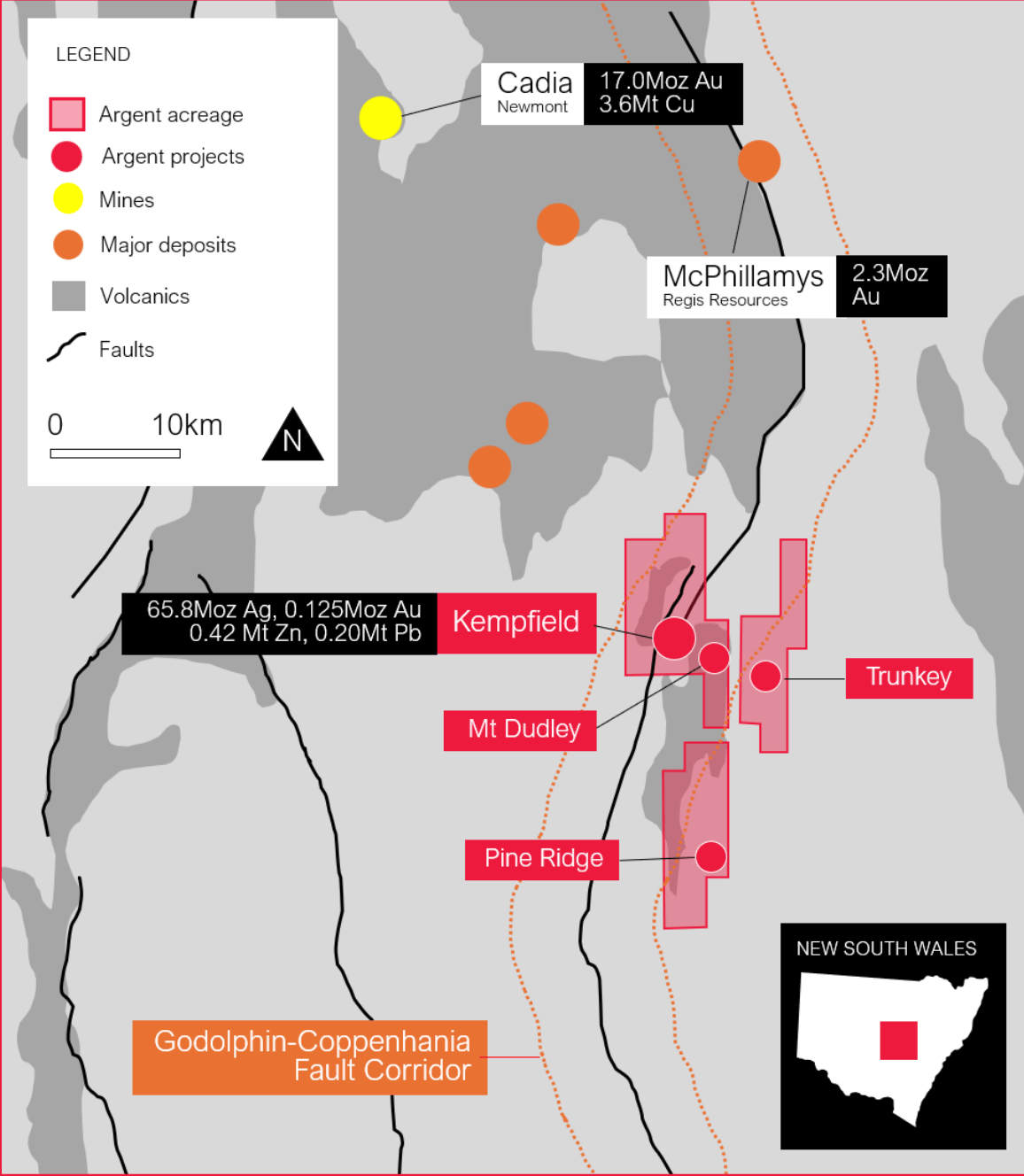
The resource contains 65.8Moz silver, 125,000oz gold, 207,000t lead and 420,000t zinc. And with the Trunkey Creek gold project only 5km away, McKevitt sees further polymetallic potential for Argent.
About 60km south-southwest of Newmont’s Cadia operation, the projects are in the same prolific region of the Lachlan Orogen as Evolution Mining (ASX:EVN)’s Northparkes copper-gold and Cowal gold mines.
Building the value case
McKevitt says the team will spend the next six to eight months completing the groundwork for a resource update, before using that data to build a cash flow model and calculate Kempfield’s NPV.
“This year is about establishing the database and resource model information we need,” McKevitt says.
“We’re currently doing an optimisation study to determine what the potential scale of the operation might be as we work towards applying for a mining lease.
“Moving into the first half of next year, the idea would be to provide study-level work that indicates the value of the asset.”
McKevitt says the goal is to then complete a DFS and technical due diligence to establish Kempfield as a financeable investment by around the first or second quarter of 2029.
“We’re also starting the longer-term processes, such as environmental permitting, which we’re commencing immediately and we’ve engaged GHD to undertake environmental work for us,” he says.
Argent has also begun stakeholder engagement, including ongoing consultation with the NSW government, as it works through the approvals process.
“Silver is classified by the State Government as a priority metal under its Critical Minerals and High-Tech Metals Strategy, and we see that as an advantage,” McKevitt says.
Also on the development side, metallurgical testwork has already demonstrated strong recoveries from Kempfield’s primary zone, including about 86% for silver and 90% for gold, and McKevitt adds there is flexibility around processing options.
Polymetallic growth potential
Back at site, Argent continues to test areas at Kempfield that remain open or have had limited modern exploration.
One is Lode 100, where McKevitt sees potential to expand the 23Moz silver resource by targeting extensions between existing lodes and deeper down-plunge mineralisation.
June quarter results followed visible gold being observed at Lode 100 in February, supporting Argent’s interpretation of a high-grade shoot within the system and the potential to increase the deposit’s gold component.
The follow-up drilling is expected to run through the end of the year.
The company is also preparing for its nearby Trunkey Creek gold project to get its first taste of the drill bit this year.
Just a few kilometres from Kempfield, Trunkey sits within a 5.5km-long goldfield that churned out nearly 3000 ounces from the 1850s to the early 1900s. Back then, grades of 12–20g/t gold were recorded and some deeper zones reached up to 3oz/t.
More recent rock-chip sampling has delivered a bonanza 1,930g/t gold, alongside less eye-popping but still high-grade set of results, including peak values of up to 73.3g/t.
Timing is ripe
McKevitt says that at previous silver prices, it was difficult to make the case for developing a deposit of Kempfield’s scale.
“But given the price having risen from around US$25 in 2024 to almost US$70 an ounce, there’s now a great opportunity to monetise the deposit,” he says.
“With AI data centres, for example, a one-gigawatt data centre requires 385,000 to 388,000 ounces of silver.
“China has approved 20 of those this quarter alone, so that represents a lot of metal demand.
“Then there’s the demand from solar panels, clean energy and electronics.”
Metals Focus analysts, writing for the Silver Institute, have forecast a sixth straight deficit in 2026 and warned of an ‘era of reduced stocks’.
On the supply side, only about 28% of global production comes from primary silver mines as most of the metal is produced as a by-product of lead-zinc, copper and gold operations.
That puts large, development-ready silver resources in an increasingly attractive position, with Kempfield’s Tier 1 location adding some precious metal dust.
At Stockhead, we tell it like it is. While Argent Minerals is a Stockhead advertiser, it did not sponsor this article.
This article does not constitute financial product advice. You should consider obtaining independent advice before making any financial decisions.