

- Grass Patch scandium resource expands to 946Mt at 50.1ppm
- Mount Ridley says it’s the largest publicly reported JORC-compliant scandium resource globally
- Selectro process offers a potential single-circuit path for three critical mineral streams
- About 80% of Mount Ridley’s tenure remains untested for scandium
Special Report: Mount Ridley Mines has more than doubled its scandium resource at Grass Patch in WA to 946Mt, giving the explorer what it says is the world’s largest publicly reported JORC-compliant scandium resource.
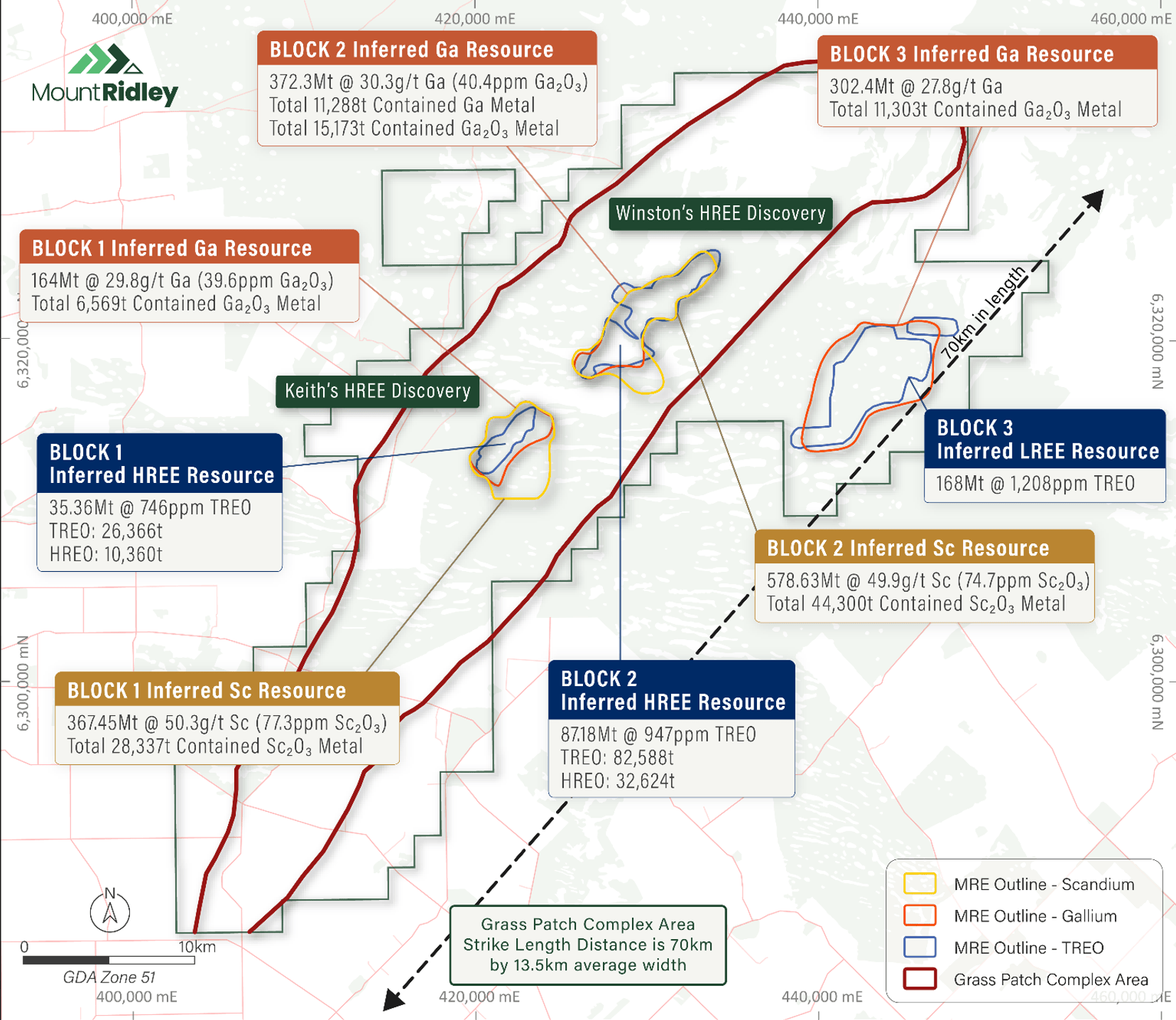
Mount Ridley Mines (ASX:MRD) has lifted its inferred scandium mineral resource estimate to 946Mt at 50.1ppm scandium, containing 47,357t of scandium metal, at a 25ppm cut-off.
That’s more than 2.5 times the tonnage of its previous 367.98Mt estimate at the project northeast of Esperance in Western Australia.
The resource combines Block 1 (367.45Mt grading 50.3ppm scandium) and Block 2 (578.63Mt grading 49.9ppm) along the same geological corridor.
Both are co-located with heavy rare earth and gallium resources in the Grass Patch regolith profile.
“We’ve now established the world’s largest publicly reported JORC compliant scandium resource, at a time when the commodity is under intense focus from governments and industry seeking to secure supply outside China,” MRD managing director and CEO Allister Caird said.
“This significant scandium resource upgrade is a clear signal that we continue to advance the project across multiple fronts in a systematic and accelerated manner.”
Scale meets processing
Resource tonnes still need a credible recovery pathway, and MRD believes its patent-pending, proprietary Selectro process could provide one.
Initial independent laboratory work at Nagrom on a 16.8kg composite from five historical diamond holes delivered 80% scandium recovery, alongside roughly 77-83% recoveries for the principal heavy rare earths tested and about 56% gallium recovery.
Selectro is being developed to recover scandium, heavy rare earths and gallium through a single hydrometallurgical leach circuit rather than completely separate pathways.
MRD believes the co-location and shared processing could translate into capital and operating efficiencies if the process is successfully proven at larger scale.
Mount Ridley lodged a provisional patent application for Selectro this month and is in discussions with engineering firms about a scoping study to inform the design and costing of a planned demonstration plant.
“Holding the largest scandium resource in the world, alongside our proprietary Selectro Process, provides a genuine pathway for Mount Ridley to commercialise this resource together with our broader commodity base at Grass Patch,” Caird said.
A tiny market facing a big demand test
Scandium can strengthen aluminium alloys while improving heat and corrosion resistance. Its major uses include aluminium-scandium alloys and solid oxide fuel cells, along with applications across aerospace, spacecraft, electronics, ceramics and lasers.
The supply problem is more economic and strategic than geological. Scandium is relatively abundant in the Earth’s crust but rarely occurs at concentrations that are economic to extract, and historically, most production has come as a by-product of other mineral-processing streams.
That has contributed to an unusually small and opaque market. NSW Resources says global scandium oxide consumption was estimated at just 30-40t in 2024 and notes that small volumes and the lack of reliable long-term supply mean the material is generally traded directly between companies.
The strategic concern is particularly acute in Western markets. The US Department of Defense said in August that no primary mine-source scandium supply currently exists globally, and foreign competitors account for about 80% of mining production and nearly all scandium processing.
Against that backdrop, the US Department of Defense’s Office of Strategic Capital has made a US$400m conditional loan commitment to Sunrise Energy Metals (ASX:SRL) to develop its Syerston scandium project in NSW.
Sunrise estimates the current market at around 50-60tpa of scandium oxide equivalent and forecasts demand could reach about 300tpa by 2030, driven by solid oxide fuel cells, defence and aerospace alloys and semiconductor applications.
Watch: Unpacking the Selectro process
What comes next for MRD?
Grass Patch also retains plenty of room for further exploration.
The two resource areas cover about 44.5km2 within a roughly 1000km2 tenure package, and MRD says around 80% of its ground remains completely untested for scandium.
Historical aircore drilling commonly stopped at or near fresh rock, leaving much of the basement poorly tested, while seven untested gravity target zones extend over a combined ~33km of strike outside the current resource areas.
Phase 2 re-assaying is under way, with additional density work planned to support potential upgrades to higher-confidence resource categories.
This article was developed in collaboration with Mount Ridley Mines, a Stockhead advertiser at the time of publishing.
This article does not constitute financial product advice. You should consider obtaining independent advice before making any financial decisions.