


- All nine holes drilled within the resource envelope intersect gold-silver
- 2026 drill program expands to ~9,000m to take in resource delineation and greenfield
- Drilling continues west-southwest into the deeper, thicker part of the Barje deposit
Special Report: Initial assays from 2026 drilling at the Barje deposit, the cornerstone of Minrex Resources’ Tlamino gold-silver project in Serbia, confirm low-cost, high-margin growth potential.
Results from the first 10 holes of the infill program at Barje demonstrate the shallow, high-grade, open-pit potential that Minrex Resources (ASX:MRR) was looking for.
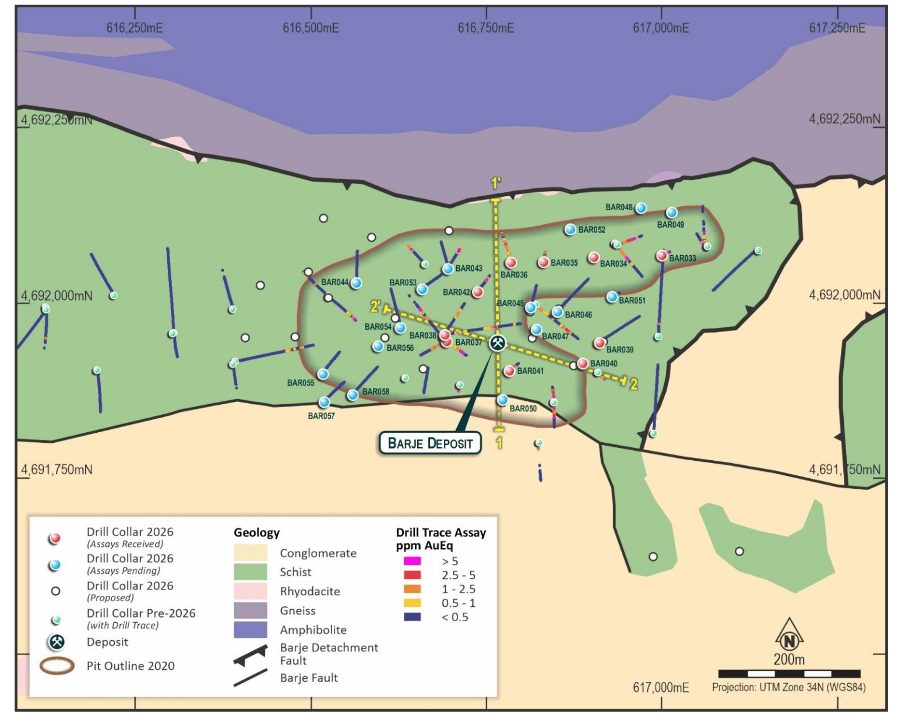
Of the 1,001m reported, all nine holes drilled within the resource envelope intersected gold-silver at the 670,000oz gold equivalent Barje deposit – the cornerstone of the Tlamino project.
As a result the drill program has been expanded to ~9,000m across resource delineation and greenfield exploration.
This reflects the company’s view that Barje represents just one outcropping expression of a much larger hydrothermal system.
“This first tranche of results confirms the deposit behaves as modelled, with high-grade mineralisation from surface in the east and grade continuity through the breccia core that underpins the resource,” CEO Max Piirto said.
“Intercepts such as 11.4 metres at 1.09 g/t AuEq from surface in BAR040 accompanied by 10.6 metres at 4.04 g/t AuEq, confirm that Barje’s high-grade zone of 470Koz at 4.7 g/t AuEq is coherent and continuous.”
The company says the results support the development case for a low-strip-ratio, low-capex, high-margin operation capable of delivering robust free cash flow.
Confirmation and consistency
Every hole in the eastern zone other than BAR039, designed to test the resource and fault boundary, returned significant gold and silver mineralisation.
And in each case the intercepts were encountered at, or close to, the depths and grades anticipated by the current geological model:
- BAR040 returned mineralisation from surface, including 11.4m at 1.09g/t gold equivalent from 0m, followed by 10.6m at 4.04g/t from 37.1m.
- BAR034 returned 3.55m at 9.01g/t AuEq from 63.7m and 4.7m at 6.86g/t from 10m.
- BAR033, the shallowest hole of the program at 41.6m total depth, returned 2.5m at 11.74g/t AuEq from 29.4m.
- BAR041 returned two near-continuous high-grade intervals – 12.8m at 2.43g/t AuEq from 32.4m and 5.5m at 2.15g/t from 45.9m, including 2.2m at 3.21g/t from 48m.
- BAR036 returned 28.5m at 1.26g/t AuEq from 26.5m, including 12m at 1.9g/t from 39.5m.
Underlining the company’s understanding of the deposit, the intersections confirmed the high-grade breccia core of the Barje system that contains 470,000oz at 4.7g/t AuEq.
That high-grade zone is particularly significant, accounting for around 70% of the ounces in Barje’s overall 670,000oz resource despite representing only about 45% of its tonnage.
And with BAR040 and BAR041 interpreted as potential extensions to the shallow high-grade envelope, there’s scope for that already substantial high-grade component to grow as drilling progresses.
Proximity to surface and grade of these results was also notable.
Most of the reported mineralisation lies within 60 vertical metres of the collar, and in several holes, begins within the first few metres of drilling.
That’s good news for strip ratio and for the sequencing of early production years in any future mining study.
Rapid progress
Drilling continues west-southwest into the deeper, thicker part of the deposit.
“We have expanded our greenfield program to approximately 5500 metres to test the Barje-Liska corridor, where the same detachment geometry that hosts Barje runs for kilometres beneath shallow cover and has never been systematically drilled,” Piirto said.
“Alongside this we have awarded the environmental baseline study and started the permitting clock.
“For a company only months into ownership of this asset, we are moving quickly and deliberately.”
Starting the clock now on the environmental baseline study de-risks the permitting timeline against the company’s development schedule.
The results represent just the first 10 out of 39 diamond holes from the initial 3200m infill program at the Barje deposit.
It was directed at the eastern extent of the mineralised system where the high-grade gold and silver envelope approaches surface.
Holes BAR033 to BAR042 were positioned on a close spaced pattern within the existing Mineral Resource, with the specific objective of confirming grade continuity and improving classification confidence in the shallowest part of the deposit.
The results deliver against that objective, the company says.
What’s next
Assays for fourteen holes are pending, with results expected in September.
Testing whether that system repeats along trend, beneath shallow cover, has not previously been undertaken with a modern, integrated exploration and drilling program.
The objective of the expanded program is straightforward: Minrex is targeting a repeat of the Barje deposit along the corridor.
This article was developed in collaboration with Minrex Resources, a Stockhead advertiser at the time of publishing.
This article does not constitute financial product advice. You should consider obtaining independent advice before making any financial decisions.