


- Prescient at the forefront of targeted cancer treatment with lead drug candidate PTX-100
- Company says the small molecule is world’s first GGTase-1 inhibitor to enter clinical development
- PTX-100 is in a Phase 2a trial for the difficult-to-treat rare blood cancer cutaneous T-cell lymphoma (CTCL)
Special Report: Much has changed in the way cancer is treated over the years, with one of the biggest shifts being away from broad-spectrum chemotherapy towards more targeted treatments designed to stop cancer cells from growing and surviving.
Prescient Therapeutics (ASX:PTX) is at the forefront of this approach with PTX-100, a small molecule which the company says is the world’s first GGTase-1 inhibitor to enter clinical development.
Licensed from Yale University PTX-100 is now in a Phase 2a trial for the difficult-to-treat rare cancer cutaneous T-cell lymphoma (CTCL) .
There are now 28 patients enrolled with a target of 40 evaluable patients at trial sites in Australia, the US and Italy with progress being made to open additional sites in France.
CEO James McDonnell said based on current enrolment trends, a Dose Optimisation Committee (DOC) meeting would be held before the end of 2026, halfway through the Phase 2a trial, to assess the optimal dose and provide guidance on continuation of the trial.
“At the moment we have two dosing arms that will be evaluated against each other, and the halfway point, when we have 10 evaluable patients in each arm, should be later this year,” McDonnell said.
“Then the Dose Optimisation Committee will probably take another look when there is 40 but there is flexibility when they continue to look.
“We’ll either have a dose identified or continue to recruit further patients until we get a confirmed dose.
“We’ll then go to the FDA with our plan for the next stage of the trial with potential for accelerated review if the FDA agrees, especially on endpoints and patient numbers.”
Opportunity for accelerated approval
PTX-100 has received US Food and Drug Administration (FDA) Fast Track designation for refractory and relapsed mycosis fungoides, the most common form of CTCL, along with Orphan Drug designations for the US and EU.
“There is certainly an opportunity for accelerated approval with good data and the agreement of the FDA so that is what we are trying to head towards,” McDonnell said.
Plans are for the Phase 2b study to go ahead with the optimal dose, and the single-arm trial is expected to enrol about 75 patients who have failed two lines of previous therapy.
McDonnell said this may change depending on agreement with the FDA.
One patient continues to receive PTX-100 on a compassionate access basis following completion of a positive Phase 1b trial, with publication on the trial findings expected.
Blood cancer causes ‘confusion’ to diagnose
McDonnell said CTCL affects ~3000 people annually in the US.
Patients often first present with skin symptoms, which can be mistaken for other conditions.
“CTCL is a malfunction of white blood cells, and they replicate uncontrollably and end up causing destruction of the skin area and as it worsens moves into lymph nodes, viscera and into blood,” he said.
“Patients may first be treated for a condition like psoriasis or eczema and are delayed in their diagnosis so the disease progresses.
“It does cause some confusion.”
McDonnell said there were CTCL expert dermatologists and haematologists.
Current treatment options for later stage disease are limited by modest efficacy and poor durability, with few patients achieving sustained responses.
“Patients graded with blood involvement so stage 4a and 4b have an 18% five-year survival,” he said.
“Typically, patients cycle through different therapies so there’s a lot of patients who are refractory or relapsed and so it’s definitely an area of unmet need, which is why we have the fast-track designation from the FDA.”
Inhibiting enzyme GGTase-1, crucial to RAS pathway
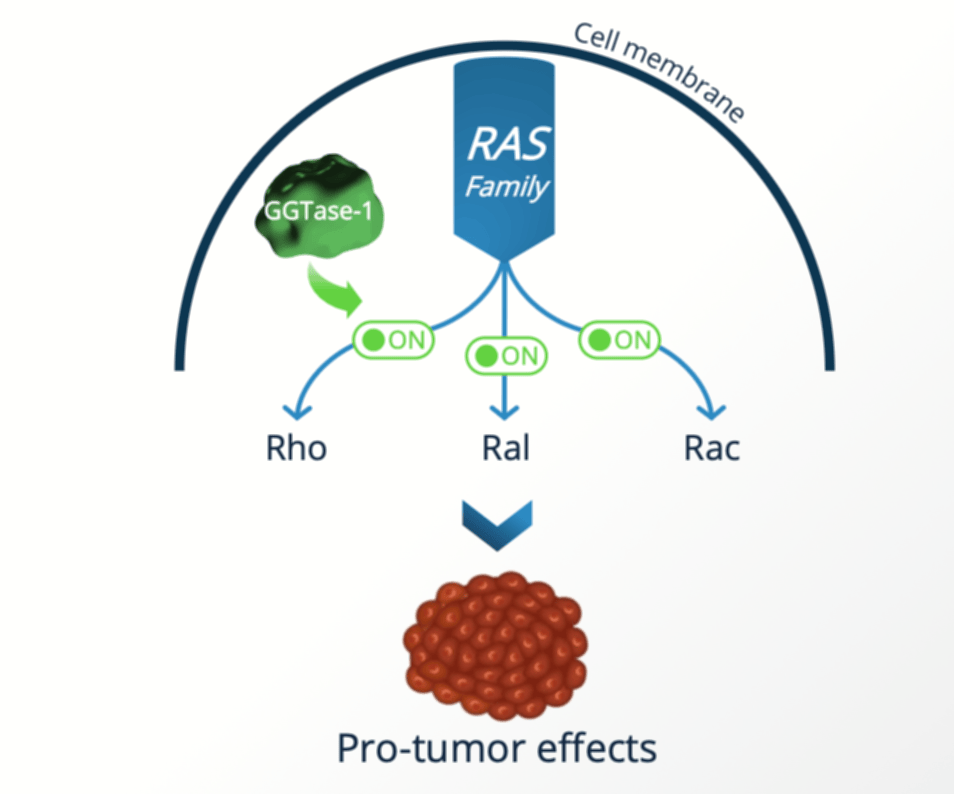
McDonnell said PTX-100 worked by blocking an enzyme called GGTase-1, which played an important role in the RAS pathway.
The pathway is one of the key signalling systems involved in cancer, helping control how cells grow and survive.
Mutations in RAS can leave these growth signals switched on, helping cancer develop and worsen.
Source: Prescient Therapeutics
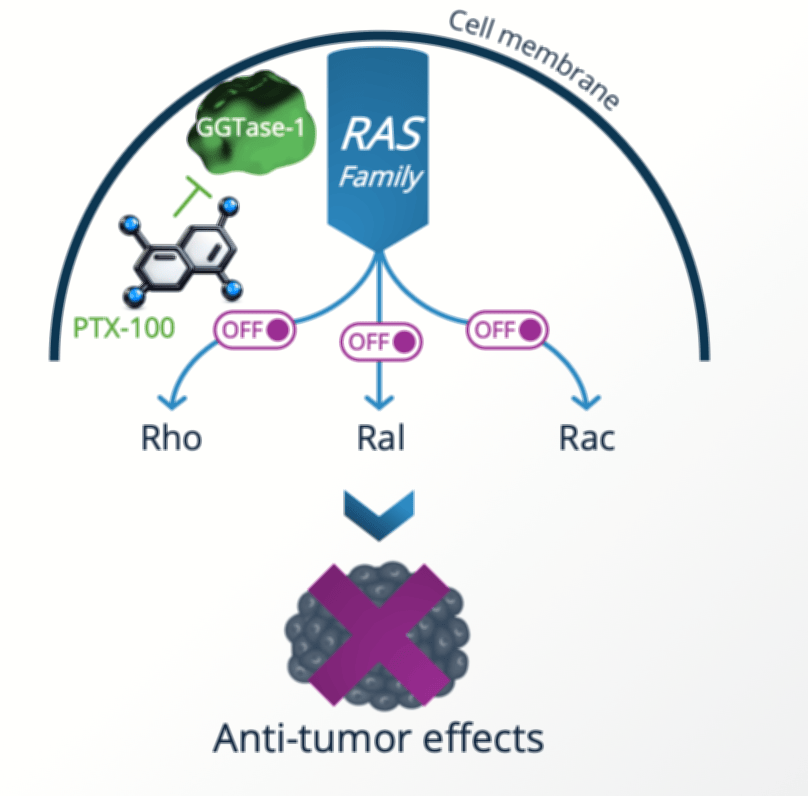
By blocking GGTase-1, PTX-100 aims to disrupt several proteins involved in the RAS pathway, potentially cutting off multiple signals that cancer cells rely on to grow and survive.
“PTX-100 sits very tightly in a pocket on the GGTase-1 enzyme, preventing it from interacting with proteins involved in the RAS pathway,” he said.
“By blocking that interaction, it disrupts signalling pathways that drive cancer cell proliferation, migration and survival.”
McDonnell said Prescient had worked with the CSIRO to do modelling of how PTX-100 works using AI and physics, while it had also done work to show how the small molecule binds to the enzyme pocket.
He said laboratory work also suggested PTX-100 reduced the amount of RAS protein reaching the cell membrane, disrupting signals that drive cancer cell growth and survival.
“There are no other GGTase-1 inhibitors in the clinic at the moment that we know of so it’s a first-in-class,” McDonnell said.
He said there were opportunities for PTX-100 beyond CTCL.
“We’re not tied to one particular mutation but to a process so with a successful outcome in CTCL we will definitely be looking at other RAS-mediated tumour types,” he said.
“We know that 22% of cancers have RAS involved but there are around 170 RAS proteins, so it is a complicated story.”
Source: Prescient Therapeutics
Narrowing focus on PTX-100 development
After taking over as CEO in January 2025, McDonnell – who is a registered pharmacist with a background in haematology – narrowed Prescient’s focus to PTX-100.
McDonnell has held senior leadership roles across the biotechnology and pharmaceutical sectors, realising the potential of PTX-100.
He was previously head of global marketing at Pharmion, which was acquired by Celgene for US$2.9 billion, before leading the Australian operations of Swiss-based Vifor Pharma ahead of its acquisition by CSL in a deal worth about A$17 bn.
Earlier in his career, McDonnell worked at ASX-listed ChemGenex, which developed the chronic myeloid leukaemia treatment omacetaxine, alongside Prescient chairman Dr James Campbell.
Prescient is now seeking partners for its cell therapy platforms, including OmniCAR, which the company acquired from the University of Pennsylvania, a pioneer in CAR-T cell therapy.
“There was an issue with the (OmniCAR) technology which we have now fixed but we are very focused on PTX-100 at this stage because it is already in clinic trials,” McDonnell said.
“We are looking at more of a partnering situation for OmniCAR because we don’t currently have the resources to run the programs.”
Recent CTCL deal highlights market opportunity
McDonnell said data from healthcare-focused market research firm DelveInsight showed in the US the expected market in 2034 would be ~US$1.2 billion.
He also noted a recent US$75 million deal between French-headquartered and Nasdaq-listed Innate Pharma and Swedish Orphan Biovitrum AB (Sobi) for a Phase III study of its drug candidate lacutamab in CTCL.
Innate is looking to also file for accelerated approval of lacutamab in Sézary syndrome, another subtype of CTCL.
Under the deal Sobi will receive exclusive global rights to commercialise lacutamab upon potential accelerated approval and will be eligible to assume full global development rights following positive Phase III results.
Innate also stands to earn up to US$40m in near-term development milestones tied to Sezary syndrome.
A further US$465m is on the table, linked to Sobi’s option for full development rights plus future regulatory and commercial milestones.
On top of that, Innate will collect tiered double-digit royalties on net sales.
“Innate have an antibody targeting an antigen, which is considered useful in CTCL and particularly Sézary syndrome and they’ve had good responses,” McDonnell said.
“It’s a rare disease but there are relapsed and refractory patients needing alternate treatments so there’s definitely a market opportunity.”
Capital raise to boost
Prescient this week announced a share purchase plan (SPP) to raise up to $7m supporting to advance PTX-100 beyond the DOC review and into the next stage of development.
Funds raised may also include evaluation of complementary pipeline opportunities.
“PTX-100 has reached an important juncture, and this SPP lets our supportive shareholders participate in funding the program through the DOC review and into its next stage of development,” McDonnell said.
This article was developed in collaboration with Prescient Therapeutics, a Stockhead advertiser at the time of publishing.
This article does not constitute financial product advice. You should consider obtaining independent advice before making any financial decisions.