


- CEO Alistair Stephens has led rare earths companies Arafura and Lindian
- Experience includes helping define 7Mt of rare earths resources
- Strong confidence in Power Minerals and its promising Morro do Ferro project
Rare earths maven Alistair Stephens helped build Arafura Rare Earths and Lindian Resources into billion-dollar companies and is now turning his decades of experience to bear at Power Minerals (ASX:PNN).
Stephens was appointed as the company’s chief executive officer in mid-March 2026 with the mandate of driving its strategy to deliver value at its South American assets.
He told Stockhead he got his feet wet in the mining industry working for KCGM and spent the first 15 years between gold and nickel mining operations in Western Australia’s Goldfields.
During this time, he progressed through various roles in mine geology, mine planning and metallurgy.
“I learnt to specialise into resource development and engineering related to mining projects, which I found to be the most interesting aspect that really got me out of bed every morning and got me enthusiastic,” Stephens said.
“My first role then was with Arafura back in 2004, when it was very much a grassroots company and took it through to the pre-feasibility stage of its current engineering design.”
After stepping away from Arafura Rare Earths (ASX:ARU) in December 2009, he worked at several other companies before serving as the the chief executive officer of Lindian Resources (ASX:LIN) between August 2022 and June 2024.
“So that’s where I’ve been, 15 years in mining operations and two decades in the rare earths and niobium business,” he added.
Arafura has committed to developing the Nolans rare earths project in the Northern Territory after securing binding offtake agreements and binding cornerstone subscription agreements with Export Finance Australia, the National Reconstruction Fund Corporation and the German Raw Materials Fund.
Lindian is also progressing its Kangankunde REE project in Malawi towards first monazite concentrate production in Q4 2026 with ore being stockpiled and construction advancing across multiple areas.
Applying lessons
Stephens noted that his experience working with the two companies had allowed him to develop skills on how to develop rare earths projects but also how not to do things.
“The latter is very important and being able to stress test situations to make sure you’ve got the most optimum outcome for your project,” he said.
“There was a fair bit of challenge with the Arafura process because there were multiple process routes that were available and you had to choose the best ones you thought were strategically correct.”
He added that he was involved in the definition of some 7 million tonnes of rare earths resources, which represents about 5% of resources globally, and is keen to bring this figure up to 8 million tonnes.
“What I bring to Power Minerals is the ability to foresee activity now that you would need to do not sequentially but in parallel that will help fast track and de-risk the project, which will be my fifth feasibility study,” Stephens noted.
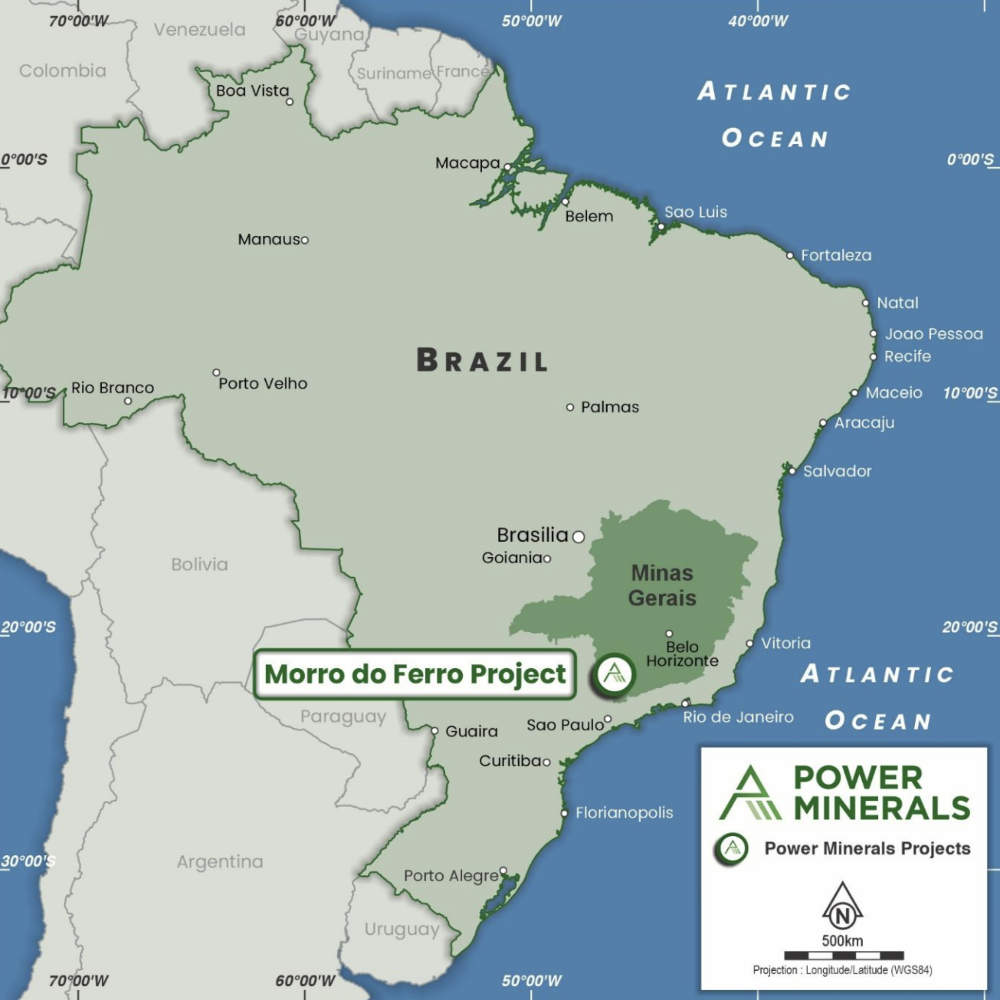
Power Minerals is focused on its Morro do Ferro rare earths project in Brazil’s Minas Gerais state, a bastnäsite carbonatite system within the Poços de Caldas alkaline complex.
Historical drilling returned standout results including 60.85m at 8.92% total rare earth oxides, 70.90m at 8.00% TREO and 60.60m at 7.02% TREO from surface to end of hole.
Morro do Ferro also hosts high-value magnet rare earth elements including significant neodymium-praseodymium and dysprosium-terbium content.
The first hole in the company’s maiden drill program returned an exceptional intercept of 116m at 4.78% TREO from surface including 31m at 10% TREO and 1.58% magnet rare earths oxide from 14m.
It also served up high-grade gallium to the end-of-hole, which could enhance the project’s future economic profile.
The second hole collared 31.5m from the first hole not only confirmed the continuity of mineralisation but also delivered the highest-ever magnet rare earth oxide grade at the project.
Hole MFSR-052 returned 137m at 4.31% TREO from surface including a peak intersection of 2m at 19.51% TREO with a project record of 3.96% MREO from 39m.
It also returned the highest reliable gallium result of 2m at 87.7ppm Ga from 83m, which is encouraging as assaying can be affected by interference from high REE concentrations.
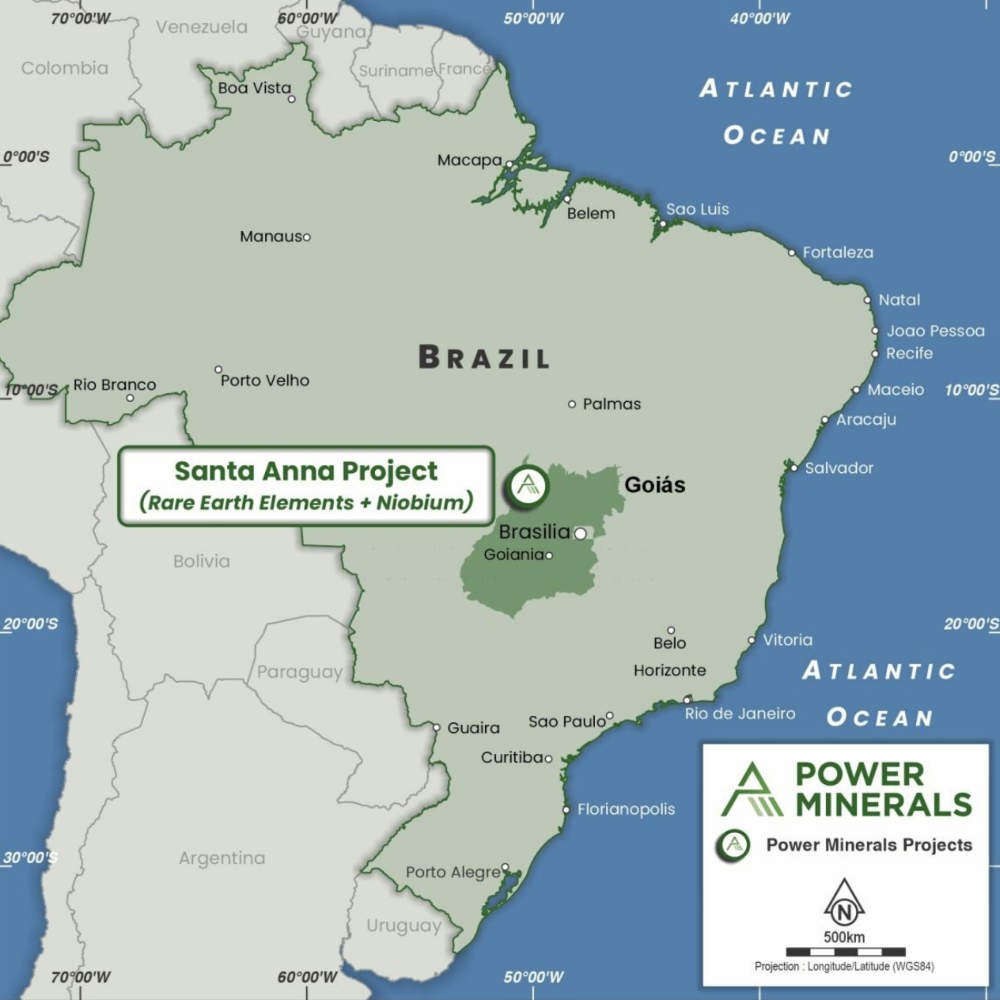
Power Minerals also holds the Santa Anna project that is interpreted to host an alkaline carbonatite complex stretching for about 2.5km which is largely unexplored.
Auger drilling has returned results such as 14.95m at 12,218ppm TREO from surface, 5m at 14,025ppm TREO from surface and 15m at 6818ppm TREO from surface.
Why Brazil is the next critical minerals frontier
Stephens also touched on why Brazil was the next frontier for critical minerals outside of its rare earths reserves, which are the second largest in the world.
He drew attention to an article in the Guardian on August 19 quoting President Luiz Inácio Lula da Silva as saying that he would dedicate his fourth term to improving education and healthcare while developing Brazil’s rare earth deposits.
“I thought it was quite unusual that a president would mix not just mining but also specifically rare earth projects in importance with education and health,” Stephens said.
“I think that signals that country’s dedication to the development of rare earths.”
He also expressed his admiration for the deep ecosystem of mining capabilities in Brazil and Minas Gerais state specifically.
“Minas Gerais is Portuguese for the General Mining District and was named as such back from when they colonised Brazil as that is where all the mines are. That’s how far back it goes,” Stephens said.
“You have a mature ecosystem between government and bureaucracies, as well as individual talent and skills in-country to be able to develop projects.
“Then you look at its economic standing in the world. It’s a particularly stable, low-risk sovereign environment that is one of the top 10 economies in the world.
“It is independent of fuel, it is net exporter of energy and has a very high proportion of renewable energies in its power generation mix. All that adds up to a great criteria that helps mining projects succeed.”
Stephens added the mining jurisdiction was very supportive.
“I think in the near-term, Invest Minas are going to propose that Moro de Ferro is a priority one project for development within Minas Gerais,” he said.
“We’re getting a lot of support out of them when we need for approvals and helping with the processes which helps us secure the funding.
“We’ve got a mining licence so they are making sure we get the environmental approval and assisting us with fast-tracking the project, which Minas Gerais is particularly good at.”
The case for Power Minerals
Besides Brazil offering a favourable environment for resource exploration and development, Stephens also outlined what he liked about Power Minerals itself.
He noted the company had first acquired the Salta lithium brine project in Argentina, which he described as “quite a nice project”, then the Santa Anna project and subsequently the Morro do Ferro project just before his appointment in March 2026.
Stephens said he was impressed by both the board and the Morro do Ferro project.
“I thought the board, especially Mena Habib and Stephen Ross, were the right kind of people who are highly credible and honest,” he added.
“That’s very important in terms of the dynamics of the success of the organisation.”
On Morro do Ferro, he said that it took mere seconds of reading through some of the statistics and highlights of its REE grades and composition to realise it was going to be extremely important project.
“The acquisition came with around 4000 metres of drilling, so there’s a fairly extensive drilling database that had been very well catalogued and stored,” Stephens said.
“The integrity of the information that was there was fundamentally good.
“Then there’s the tenor, so not only are there high grades of rare earths, but this one is particularly unusual in that they’re quite highly elevated in the valuable magnetic rare earths suite.”
He also noted that while the elevated heavy rare earth content is not necessarily a commercially fundamental part of the operation, it had significant strategic importance.
“I think Morro do Ferro has got a great combination of jurisdiction, location, tenor and rare earth mix that I think will probably be, outside China, the third most important rare earth project in the world,” Stephens claimed.
Road ahead
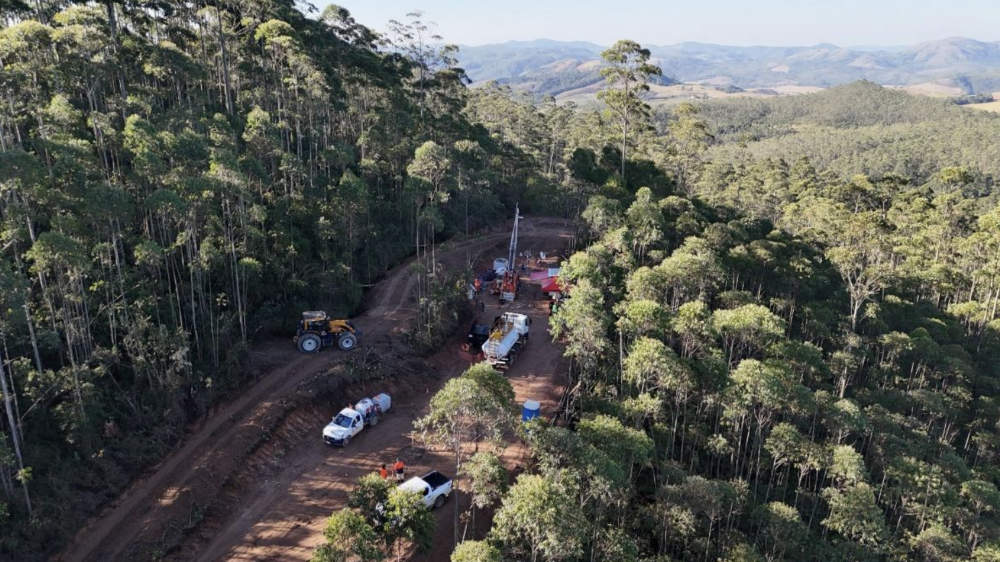
Looking ahead, Stephens said the company would now progress Morro do Ferro into a definitive feasibility study.
“The first step is to do extra drilling and convert the current drill database into a mineral resource estimate,” he said.
“We hope to have an inferred resource by the end of this year with a higher confidence indicated resource following in the next quarter.
“We need to undertake first stage metallurgical testwork plus rudimentary engineering studies such that we can lead into a scoping study which we’re hoping would eventuate by June 2027.”
This will be followed by further studies that would go into a pre-feasibility study and then a DFS, which he suggested could take about 18 months after the scoping study though the exact timeline would be based on the appetite for risk and how well things are going.
Stephens noted that fellow Australians Meteoric Resources and Viridis Mining and Minerals were neighbours in the same district.
“We have watched them and see which aspects have been highlighted in their processes that we would take to heart as being important issues.” he said.
Not everything can be used through as Morro do Ferro hosts primary resource mineralisation while the ionic clay-hosted deposits of the two companies are secondary, sedimentary wash deposits.
That said, there’s a theory that Morro do Ferro might be one of a number of sources that fed into the ionic clay-hosted deposits, a belief supported by the ratio of rare earths in the clays compared to the ratios in the project.
While processing routes for clay-hosted and primary mineralisation are completely different, the ratios support the strong enrichment of valuable terbium and dysprosium at Morro do Ferro.
This will help the company understand how the mineralisation was formed, enabling Stephens to draw on his experience to determine the best route forward.
He noted that he was particularly interested in unlocking the value chain from Morro do Ferro into end products.
“Not as a primary role for Power, but as part of a consortium or a collaboration in the industry to assist in funding.” Stephens added.
“That’s the bottleneck we have within industry. Not the rare earths but our processing capability.”
This will leverage his expertise in resource development and engineering studies for rare earth projects as well as Brazil’s interest in becoming a significant producer of finished rare earth products.
At Stockhead, we tell it like it is. While Power Minerals is a Stockhead advertiser, it did not sponsor this article.