
- With a generation of Americans becoming sober-curious, Calmer Co has launched its US kava expansion push as alcohol consumption falls
- The company has worked hard to promote improved production and manufacturing standards in the South Pacific.
- CEO Zane Yoshida says legitimate clinical studies affirm kava as an effective anxiety treatment
The founder and CEO of The Calmer Co International (ASX:CCO), Zane Yoshida, equates the nascent kava industry with Australia’s blooming medical cannabis sector, now worth $1 billion annually.
The difference is the anxiety-reducing root synonymous with South Pacific culture has a track record that would put pot to shame.
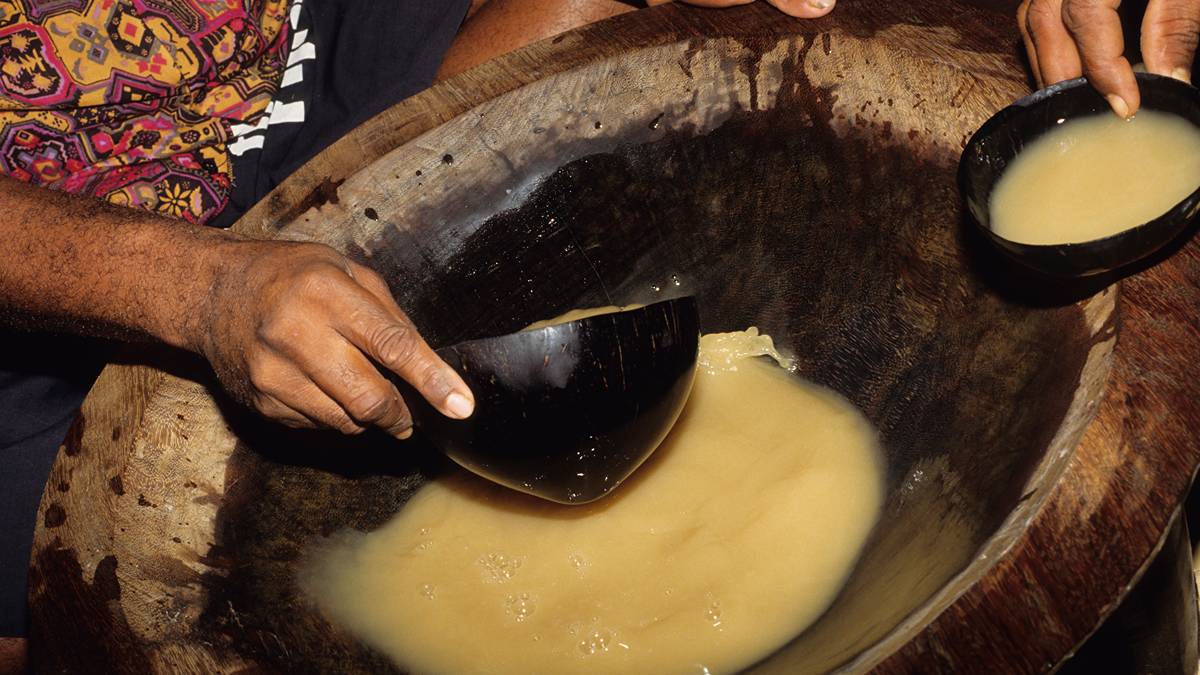
The denizens of countries including Fiji and Vanuatu imbibe kava from coconut shells in the evening, in a communal setting. The effect is mildly numbing/tingling with potentially mild euphoria.
Yoshida notes that until 2002 kava was a prescription medicine in Germany.
A 2002 review covered nine double-blind, randomised controlled trials involving 808 patients, with the results broadly supporting kava’s effectiveness in treating anxiety.
That same year, German regulators moved to withdraw marketing authorisations for kava-containing medicines amid concerns over potential liver toxicity, sparking a long-running regulatory and legal battle.
German courts ultimately overturned the revocations in 2014 and 2015, allowing affected kava medicines back under strict safety conditions.
Yoshida adds that studies by the University of Melbourne, Queensland Uni and the National Institute of Complementary Medicines have shown kava to be safe, non-addictive and effective for anxiety.
“There are not too many botanical functional ingredients that have been through the rigor and the quality requirements, clinical trial-wise, to show their efficacy and safety,” Yoshida says.
So why was kava sent to the dog box?
“I’m a conspiracy theorist in this regard,” Yoshida says.
“As soon as kava captured significant market share for benzodiazepines, suddenly it was banned despite those numerous clinical trials.”
It’s all in the definition
The only ASX-listed kava exposure, Calmer Co (previously Fiji Kava) is on a mission to promote kava as a mainstream herbal-style product.
As with cannabis, the regulatory overlays are bewildering as they cover food, supplement and prescription standards.
In Australia, kava is classed as a food and sold on the shelves of Coles and Woolworths.
In the US the regulatory tapestry is complicated … as usual.
The substance is classed as a food, but only when it’s mixed with water as per the traditional approach.
“But everything else outside of that, whether that be a flavored carbonated shot, a canned beverage, or a flavored carbonated powder, is regulated as a dietary supplement,” Yoshida says.
This means the product can only be sold via specialist nutraceutical and supplement channels. But that hasn’t stopped hundreds of kava bars springing up.
Didn’t we say it was complicated?
So far, Hawaii is the only US state to bestow kava with ‘generally recognised as safe’ status.
Spreading the word
Calmer Co recently fronted US congressmen and US Food and Drug Administration (FDA) reps to highlight efforts to improve quality standards for South Pacific kava.
In this regard, Yoshida has more street cred than a Harlem hip-hop artist.
He has been a member of the Fiji Kava task force and has represented Fiji at quality control meetings for a decade.
He also sits on the regional standards committee with Standards Australia, which held its inaugural meeting in April.
“This is to ensure we have a sustainable quality supply chain through to export to meet food safety standards as a minimum,” Yoshida says.
Purity at source
Rather like those German purity laws that dictate beer can only be made from water, hops and barley – filtered through a fraulein’s dirndl – Calmer Co is heavily involved in efforts to ensure product purity and consistency at source.
For example, extraction should involve pressure, temperature and water, rather than solvents such as acetone and ethanol.
A current bill before Fiji’s parliament requires kava exporters to be properly registered and regulated. Transgressors face heavy fines.
“Finally, we are starting to regulate the industry and it’s long overdue,” Yoshida says.
“Companies like us have been playing within this quality framework since day one.
“It’s only now that the Fiji government is recognising that … kava consumed domestically and exported meets food safety standards.”
The bill proposes a grace period, accompanied by an education campaign.
“How do you control bacteria levels with kava harvested in rural Fiji, washed in rivers and dried on tin roofs,” Yoshida says.
“There has to be some leeway.”
Putting the Fizz into kava
For most suppliers, dealing with Coles and Woolworths induces anxiety levels that even a bucket of kava couldn’t ameliorate.
But Calmer Co to date has found the experience as breezy as a lovo (hangi) under the palms with the ukelele and a communal singalong.
The supermarket duo accounted for most of the company’s Australian retail sales, which amounted to $3.3 million in the year to June 30, 2026, compared with $2.53m previously.
Fiji Kava products rank number one and number three in Coles’ ‘stress’ category.
The trouble is, kava has a bitterness and muddy water colour that makes the Yarra look transparent.
Calmer Co seeks to rectify these with a new product called FZZR.
The FZZR format combines kava powders with effervescent granules and flavourings such as pina colada.
FZZR should hit Coles supermarket shelves in October.
Have another kava for the road
Calmer Co is making its US putsch at the right time.
US alcohol sales are at a 93-year low – yep, since the end of Prohibition – and close to one-third of Gen Zs don’t drink booze at all.
Yoshida says around 600 kava bars have sprung up in the US, concentrated in Florida.
“I’ve been to close to a hundred kava bars and they vary from tin shacks to fancy fine-dining-type establishments,” he says.
A recent Fijian trade delegation estimated 10 to 15 bars were opening monthly in the US.
Calmer Co is not in the business of running kava bars and does not intend to be. But Yoshida cites a huge opportunity in California.
Let’s face it, the Rodeo Drive crowd love to embrace the Next Big Thing, whether it be ketamine, kava or Gwyneth Paltrow’s jade eggs and vagina candles.
Psst! I can get it wholesale
‘Wholesale’ suggests dour anonymous stuff relative to the buzzy retail side. But it’s a crucial leg to Calmer’s growth story.
Yoshida says wholesale means the company does not have to spend heavily on direct advertising and marketing.
“You work with a distributor and they carry that cost,” Yoshida says.
“For us, this contributes in a meaningful way to our net contribution margin, alongside consumer brands through retail and online channels.”
The company has embraced Amazon with enthusiasm.
Last week Calmer secured a deal with an unnamed multinational food company, for the rights to Calmer’s kava extracted ingredients range.
Crucially, the deal involves $25 million of minimum purchases over three years.
Earlier in the month, the company entered another contract to access noble kava – a.k.a. the good stuff – from Vanuatu and PNG.
In late July Calmer Co entered a heads of agreement to partner with Fiji’s Kaiming Agro Processing for a kava supply and manufacturing deal.
Kaiming is building an advanced manufacturing facility in Navua on Viti Levu, which should fire up by December.
Calmer Co retains ownership of its brands, which include Fiji Kava, Taki Mai and Authentic Kava.
Beyond kava
Kava is Fiji’s number one export, followed by turmeric and ginger.
Via the Kaiming compact, Calmer Co has exclusive offtake rights to all three. Kaiming extracts ginger and turmeric at facilities in India and Victoria.
Yoshida says lab tests suggest the Fijian turmeric contains five times as much curcumin as Indian and South American samples.
Curcumin is the yellow-pigmented compound that makes turmeric, well, turmeric.
Meanwhile, there’s a dearth of organically certified ginger that the company could help satiate demand for.
But kava should continue to drive Calmer Co’s fortunes.
The company cites current global kava demand of $2.8 billion and expects this to grow to $11bn by 2033.
Calmer Co values the market for ginger extracts at $2 billion, while the turmeric/curcumin trade is worth $150 million.
Pushing for mainstream acceptance
Yoshida offers some real-world evidence on kava’s benefits: himself.
“I have drunk kava for close to 40 years and there’s nothing wrong with it,” he says.
“As soon as a herbal medicine makes it to mainstream and gets some momentum, the big pharma companies want to keep it out.”
Calmer Co reported June (fourth) quarter receipts of $1.875 million, taking the year’s tally to $7.3m.
The company recorded $802,000 of cash flows for the quarter and a $3.03 million deficit for the year.
The company has launched a rights offer to raise $3.5 million, which closes today.
The funds will mainly be used to pay out convertible notes and support a build-up of wholesale inventory.
Yoshida cites the eye-opening stat that around 10.7% of adult Americans have tried kava.
“Kava is now coming back and it’s going to be way bigger than it was historically,” he says.
“But we need the right foundations for growth and … the right quality frameworks around that”.
At Stockhead, we tell it as it is. While Calmer Co is a Stockhead advertiser, the company did not sponsor this article