


- EIA and RIMA lodgement starts Araxá’s three-stage environmental licensing process
- Worley-led feasibility work is advancing in parallel with permitting
- Brazil’s critical-minerals push adds strategic weight to the development pathway
Special Report: St George Mining has formally started environmental licensing for a potential rare earths and niobium mine and industrial complex at its Araxá project in Minas Gerais, Brazil.
St George Mining (ASX:SGQ) has lodged an Environmental Impact Assessment (EIA) and Environmental Impact Report (RIMA) with the State Environmental Foundation of Minas Gerais (FEAM) as part of its application for a Preliminary Licence. It is the first of three environmental licensing stages.
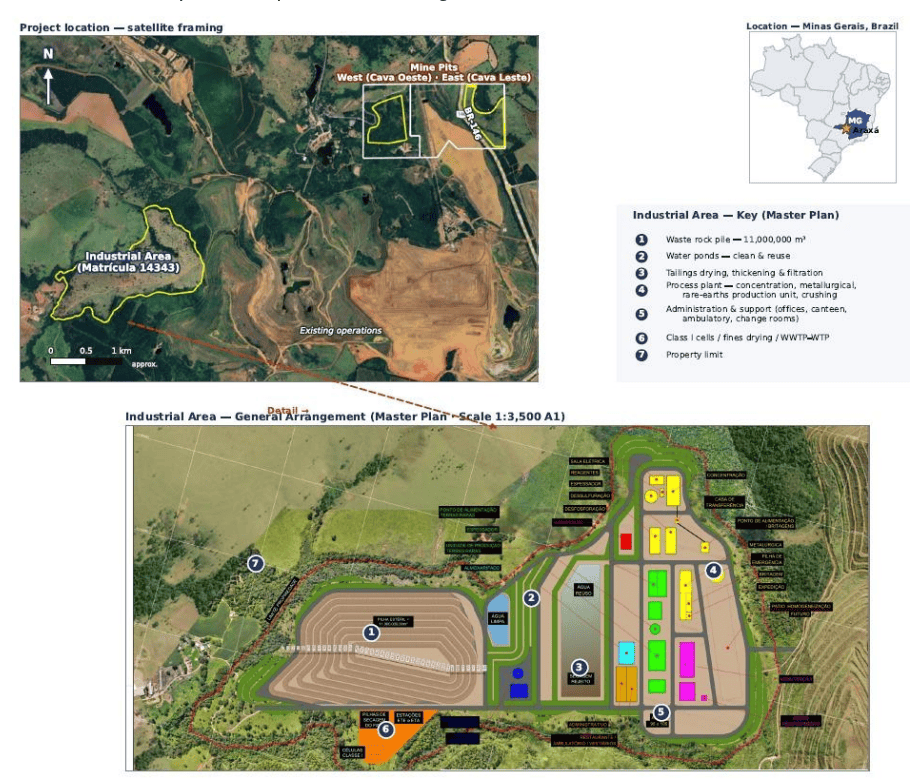
The filing follows about 14 months of studies and fieldwork. The roughly 800-page assessment covers a greenfields open-pit operation and new industrial complex incorporating mineral processing, refining and metallurgical plants, as well as waste, tailings and supporting infrastructure.
SGQ executive chairman John Prineas said the company had moved from establishing Araxá’s resource credentials into the formal licensing phase.
“We have established world-class scale and grade at the Araxá Project and are now delighted to announce the formal commencement of the licensing process for a potential mining operation,” Prineas said.
“Our march towards a development at Araxá has accelerated with this important milestone in the critical path to becoming a globally significant producer of niobium and rare earths.”
Three gates between filing and operations
The lodgement starts the process rather than completing it.
FEAM will technically assess the LP application, with the State Environmental Policy Council (COPAM) responsible for deliberation. The Preliminary Licence assesses the environmental feasibility, location and concept of the project and includes a public participation process and hearing.
An Installation Licence would then authorise construction after approval of an Environmental Control Plan, while the final Operation Licence would allow operations only after compliance with the preceding licence conditions and environmental controls.
St George expects, based on industry experience, that the LP and Installation Licence stages will be completed within 12 months. The Operation Licence would follow completion of construction, which SGQ estimates could occur in the second half of 2029, subject to conditions and a final investment decision.
Permitting is running alongside the feasibility study led by Worley, ongoing metallurgical work and evaluation of whether existing regional processing infrastructure could provide an alternative to a wholly greenfields processing route.
That work now sits on a substantially stronger resource base. The August MRE lifted Araxá to 111.2Mt at 3.57% TREO, 0.68% NdPr and 0.57% Nb₂O₅, with 75.2Mt in the higher-confidence measured and indicated categories. That represented a 155% increase in M&I tonnes from the March estimate.
Brazil’s critical-minerals race gets real
The permitting push is landing as governments and industry try to reduce their reliance on some unusually concentrated critical-mineral supply chains.
For magnet rare earths, the International Energy Agency says China accounted for 91% of global refined output and 94% of sintered permanent magnet production in 2024.
Demand for magnet rare earths outside China is projected to rise 50% by 2035, while existing and announced diversified capacity would cover only about half of mining demand, a quarter of refining needs and less than a fifth of magnet demand.
That supply equation gives projects outside China strategic relevance, particularly where mining can be paired with processing and refining.
Niobium presents a different geopolitical picture. Brazil accounted for about 93% of global production in 2025, according to the US Geological Survey, with Canada supplying another 5%. Niobium demand is predominantly tied to its use as an alloying element in steels and superalloys, including high-performance aerospace applications.
There’s also precedent in Minas Gerais for rare earth projects progressing through the same permitting system. Meteoric Resources’ Caldeira project secured its Preliminary Environmental Licence in December 2025. And Viridis Mining and Minerals lodged an EIA and RIMA with FEAM for its Colossus project in January 2025 as part of its Preliminary Licence process.
This article was developed in collaboration with St George Mining, a Stockhead advertiser at the time of publishing.
This article does not constitute financial product advice. You should consider obtaining independent advice before making any financial decisions.